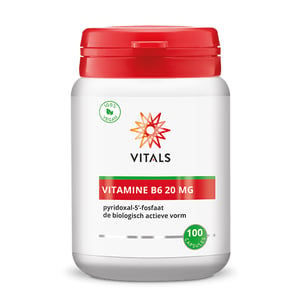
Vitamin B6
Vitamin B6 (pyridoxine) is an exceptionally important substance, as it is involved in numerous bodily processes. Vitamin B6 plays a role in energy metabolism, digestion, and brain function.
Vitamin B6 is also recommended for discomforts related to menstruation, as it contributes to the regulation of hormonal activity.
NEW INFORMATION (12-2-2018):
The Ministry of Health, Welfare and Sport has set a date for the legal maximum for vitamin B6 to come into effect. From 1 October 2018, the maximum daily dosage will be 21 mg of vitamin B6, regardless of the form used. Thus, no distinction is made between pyridoxine or the co-enzymatic pyridoxal-5 phosphate (P-5-P).
Additionally, from 1 October, a mandatory warning text for children must be included on all labels of supplements containing vitamin B6. New labels will feature the warnings below.
- When the product contains a maximum of 3 mg vitamin B6 per daily dose:
This dietary supplement is not suitable for children under 1 year. - When the product contains more than 3 mg vitamin B6 per daily dose and deviating from the previous point: This dietary supplement is not suitable for children up to and including 3 years.
- When the product contains more than 5 mg vitamin B6 per daily dose and deviating from the previous two points: This dietary supplement is not suitable for children up to and including 10 years.
- When the product contains more than 7 mg vitamin B6 per daily dose and deviating from the previous points: This dietary supplement is not suitable for children up to and including 17 years.
(End of new information.)
*****
For most people, dosages up to 200 mg per day are completely safe. A few individuals may develop neuropathy over time (several months to years) at such a dose, which can manifest as tingling limbs. This neuropathy is reversible: once intake is stopped, the complaints disappear. In Europe, a safe upper limit of 25 mg per day has been established for vitamin B6. This is an extremely cautious upper limit, based on a controversial study. Other authorities have disregarded this study and concluded a safe level that is much higher. For instance, the American Food and Nutrition Board and the global expert group IADSA consider 100 mg of vitamin B6 per day safe.
Many popular multivitamins contain dosages between 25 and 100 mg B6 per day, which, given the scientific literature and the experience of countless users, can be considered completely safe.
Since its inception in 1991, the Lareb (Centre for Adverse Drug Reactions) has received only six reports of people who had complaints about dietary supplements with vitamin B6. It is unclear whether these complaints were related to the intake of vitamin B6; they are merely reports.
Neuropathy can also occur in people who do not take extra vitamin B6 at all. The literature shows that there is no relationship between the occurrence of the side effect and the level of blood value.
When blood tests show that someone has a relatively high B6 level, it does not mean that the person is also at risk of developing neuropathy. It simply means that the person has more B6 in the blood than other people. When using a dietary supplement, it is not surprising that the amount of B6 is higher than the national average.
Finally: a DEFICIENCY of vitamin B6 can also lead to neuropathy!
P5P
Vitamin B6 is available in the common form of pyridoxine HCl and as pyridoxine-5-phosphate (P5P, also known as PLP), the co-enzymatic form of B6. So far, no side effects are known from products with P5P.
recommended
1 products